Get Familiar: Faria van Creij-Callender
Interview by Liesje Verhave | Photography by Tengbeh Kamara
For Faria van Creij-Callender, painting is more extensive than just image-making. It’s a method of navigating identity, space, and belonging. Drawing from personal memory, family archives, art historical references, and recent experiences in Suriname, the Dutch-Surinamese artist creates dreamlike worlds that sit between reality and imagination.
Her paintings explore what it means to exist between cultures without the need to choose one over another. Figures emerge from layered compositions that blend observation, memory, and fiction. Reflecting a lived experience that is deeply personal and widely relatable. Whether exhibiting in museums, developing new bodies of work inspired by travel, or preparing for major art fairs, van Creij-Callender continues to build works with a visual language rooted in nuance, curiosity, and self-discovery.
Following her recent solo exhibition at Lang Gallery and being exhibited at the Dordrechts Museum for winning the Scheffer Kunstprijs 2026, we caught up with the artist to discuss representation, Surinamese identity, painting practices, and the creative impact of her first visit to Suriname.

How did you first get into painting?
My mother was a painter, so art was always accessible to me. There was always paint around the house, so making things felt very natural. But that being said, I never planned on becoming an artist. I first studied several different subjects at university before realising that art history was what interested me most. At some point, I realised: I don't just want to study art, I want to contribute to it. Through trying different things that didn't quite fit, I realised that everything I felt passionate about could be expressed through painting.
I studied illustration before moving into fine arts at KABK, and once I got there, I never really questioned it again. It felt like the right path.
Your work is currently being shown at the Dordrechts Museum as part of De Scheffer Kunstprijs. How does it feel to see your paintings in a museum setting?
It's incredibly special. It was the first time my work had ever been shown in a museum.
There is always this balancing act of how people perceive your work. You don’t want to be seen only as a Black artist. For me, being Black and Surinamese is where the work starts, but there are many other aspects to my identity. My family comes from many different places, and there are many layers to who I am.
Seeing my work in a museum felt like a meaningful step forward. Simply having that presence as a Surinamese artist in that space already means a lot.
Has recognition changed your confidence as an artist?
Recognition is always nice. After graduating from KABK, there was a real question about whether I could continue my practice full-time or if I would need another job.
A few months later, I was very fortunate and received the Royal Award for Modern Painting in 2025, which gave me both recognition and practical support. It helped me pay for studio rent and materials. But the most important validation comes from the work itself. Every time I finish a painting, I feel a sense of peace. It reminds me that this is what I'm supposed to be doing.

Many of your paintings embrace multiple identities rather than choosing between them. Why is that important to you?
Growing up, I often felt like I had to choose between different sides of myself. My mother is from Brabant and my father's family is Surinamese. There was always this feeling of being asked to identify with one side or the other.
But that wasn't my reality. I've always felt like I existed somewhere in between. When I was studying, I found inspiration in Black American artists and saw parts of myself reflected there. But I still wanted to express something more specific to my own experience. I couldn't really find images that reflected that feeling of existing between cultures, so I decided to create them myself.
Your work often exists somewhere between reality and imagination. How do your characters come to life?
It happens in many different ways. This year, I visited Suriname for the first time and took hundreds of photographs. Many recent paintings are based on those images and the people I encountered there. Other works begin with art history. I'll look at Renaissance paintings or 18th- and 19th-century works and borrow elements like compositions, poses, or gestures. I also use family archives, old photographs, objects from daily life, and references from my own surroundings.
Then I start cutting, combining, and pasting everything together until it becomes a world of its own. All those references merge into a world that feels grounded in reality but also dreamlike. It’s important to me that I recognise something from my own life within the work, but also that I recognise my community and people who look like me.
You mentioned that aspects of yourself appear throughout your paintings. What role does self-portraiture play in your work?
Whenever you paint faces long enough, they eventually start looking a little bit like you.
For me, it begins with wanting to recognise myself in the work. Sometimes I use my own features as references because it's practical. If I need to understand how an eye tilts or how light falls across a face, I can simply photograph myself. But I don't necessarily want every painting to be a portrait of me. I use myself as a starting point, then move away from it.

You recently visited Suriname for the first time. How did that experience affect your work?
It had a huge impact.
I took so many photographs and filled sketchbooks with ideas. I wasn't painting while I was there because I wanted to fully experience the moment, but I was constantly drawing and collecting references. Being in Suriname for the first time made that process even more meaningful. I wanted to capture the atmosphere, the colours, the air, the feeling of being there as quickly as possible so I could hold onto that experience for longer.
When I returned to the Netherlands, all of those experiences immediately became paintings.
Would you describe yourself as a nostalgic person?
I’m definitely a nostalgic person. Memory enters my work in different ways. Sometimes I'll experience something and feel an immediate urge to paint it. I'll come back to the studio and want to begin as soon as possible.
Other times, a memory takes much longer to reveal its importance. Some moments only become meaningful years later, and then I suddenly feel the need to return to them through painting. Because I work with so many references and images, memories often become layered. Sometimes a memory isn't complete on its own and needs other references to help build the image. Different memories move at different speeds.
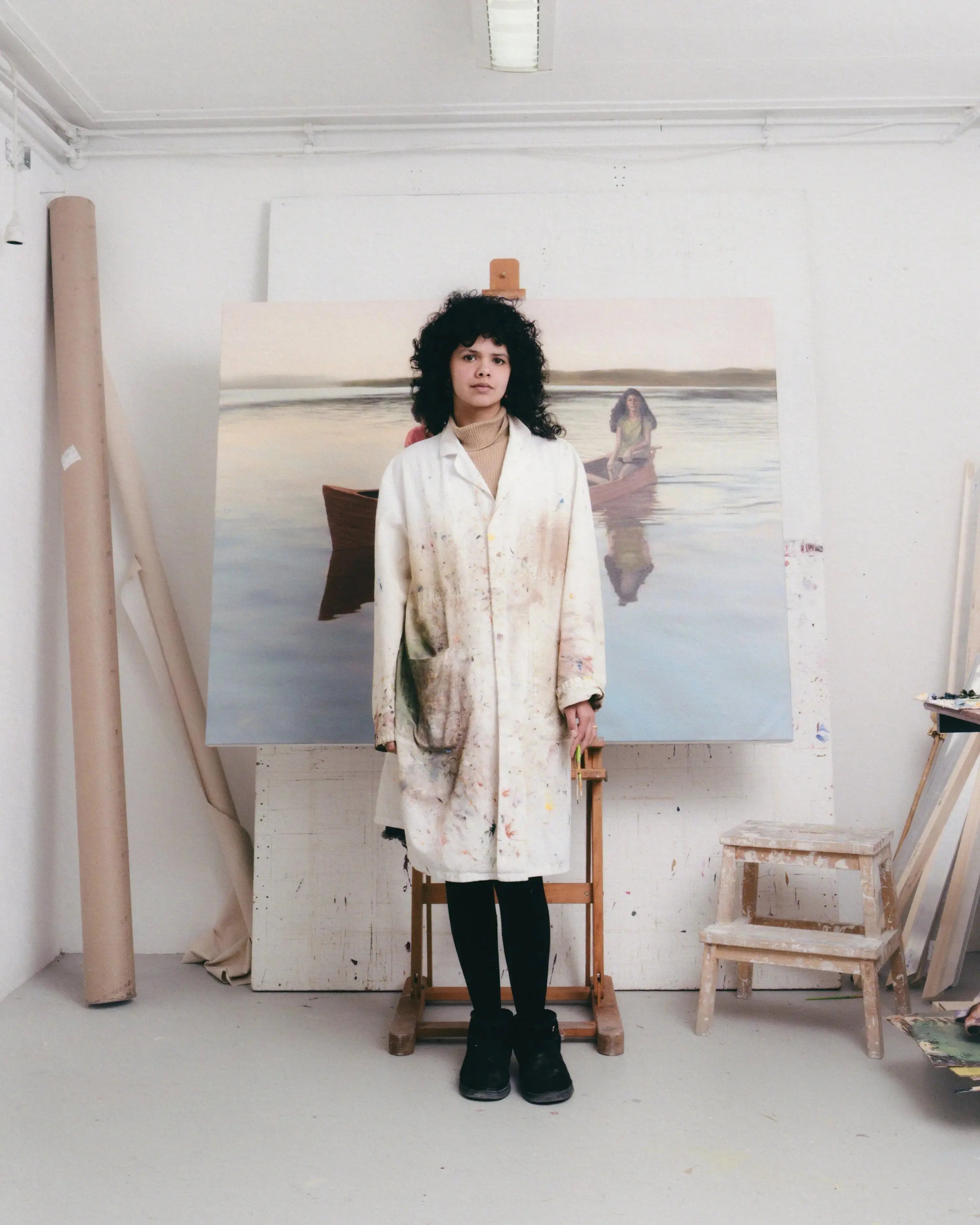
For example, one of the paintings behind me was inspired by my girlfriend in the Surinamese jungle. I remember taking the photograph and immediately wanting to return to the studio and paint it. There was a sense of urgency to that work. At the same time, another painting contains two figures in the distance who appear to be sharing their first kiss. That image was also inspired by a moment in Suriname, but it developed much more slowly. It required many different elements to come together before it felt complete.
So memory exists at different paces within the work. Some moments arrive immediately, while others take years to fully form.
What does a typical day in the studio look like?
I usually start with a run in the morning and then head straight to the studio.
I work with oil paint, so planning is important. Each layer needs time to dry, which means I usually have three paintings in progress at the same time.

What part of the painting process do you enjoy most?
The third layer.
The first layer is about structure. The second introduces colour. But it's the next stage where the painting really starts revealing itself. That's the moment I love most because I can finally see whether the image is becoming what I imagined. It's the point where the painting begins to tell me where it's going. It's not finished yet, but suddenly I understand its direction.
Your recent solo exhibition at Lang Gallery was inspired by your trip to Suriname. What did that show represent for you?
It represented a very immediate response to the experience.
I returned from Suriname with so many ideas and was able to translate them into paintings almost immediately. Then, shortly after finishing them, I was able to show them to an audience.
That felt incredibly rewarding. The opening also incorporated Surinamese food, which made the exhibition feel multi-layered and communal. It became a broader celebration of the experience and the culture that had inspired them.
Where do you usually find inspiration?
Travel definitely helps, but it's not my only source.
I spend a lot of time looking at historical paintings and visiting exhibitions. I'm particularly interested in how artists capture light, posture, and atmosphere. Running is also surprisingly important. That's often when ideas come together. Things that feel complicated in the studio suddenly become clear when I'm moving. My girlfriend and I always try to run together, wherever we are. We even kept running while we were in Suriname, although doing that in 32-degree heat was definitely intense. It was very sweaty, but we still did it.
Running has become such an important part of my routine that I take it with me wherever I go.

What's next for you?
The main focus right now is preparing new work for Unfair Amsterdam. I'm also working towards several upcoming exhibitions that I can't fully announce yet, but they're very exciting. For now, I'm concentrating on making the strongest work possible and continuing to build on everything I've learned over the past year.
Faria van Creij-Callender's work is currently on view through the Dordrechts Museum Kunstprijs exhibition, and will show a new set of works at Unfair Amsterdam later this year. Visit her work in person as she continues to explore identity, memory, and belonging through vibrant paintings that bridge personal experience and collective histories.